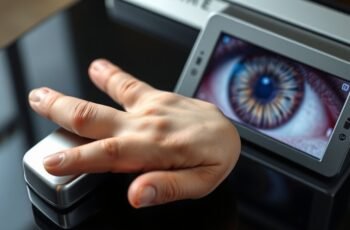
Some might assume that choosing between iris recognition and retinal scanning is straightforward, but the decision involves nuanced differences in accuracy, practicality, and security levels that can markedly impact implementation. While retinal scans offer higher precision, they are more invasive and less adaptable to diverse environments. Conversely, iris recognition provides a convenient, contactless option suitable for large-scale deployment, yet its reliability can vary. To determine the best fit, understanding these technical distinctions is essential.
Key Takeaways
- Iris recognition analyzes surface patterns of the eye, while retinal scanning maps internal blood vessel structures inside the retina.
- Retinal scanning offers higher accuracy and security but requires specialized equipment and close proximity.
- Iris recognition is more environment-resistant, faster, and suitable for large-scale, contactless identification.
- Retinal scans are more invasive, sensitive to environmental factors, and better for ultra-secure, low-volume settings.
- Privacy and ethical considerations favor iris recognition due to its less intrusive data collection.
How Do Iris Recognition and Retinal Scanning Work?
Although both iris recognition and retinal scanning are biometric techniques used for identification, they operate through fundamentally different mechanisms. Iris recognition analyzes the unique patterns in the colored iris, which exhibit subtle variations in color and texture that remain stable over time. These patterns are captured using high-resolution imaging, making the system less susceptible to factors like age effects or minor physiological changes. Retinal scanning, on the other hand, maps the unique blood vessel patterns in the retina itself, which are less influenced by external factors such as color variations or aging. While retinal scans are highly precise, they can be affected by age-related changes in blood vessel structure, though these variations are generally minor. Both methods leverage distinct physiological features for accurate identification, with iris recognition favoring surface pattern stability.
Key Differences in Eye Anatomy and Scanning Processes
The fundamental differences in eye anatomy underpin the distinct scanning processes used in iris recognition and retinal scanning. The eye structure varies considerably: the iris is an externally visible, pigmented membrane surrounding the pupil, allowing for non-invasive imaging through optical techniques. Retinal scanning, however, targets the inner eye, specifically the blood vessel patterns in the retina, requiring direct access via specialized optics and often pupil dilation. These anatomical distinctions influence their scanning techniques: iris recognition captures high-contrast, textured patterns on the iris surface, typically using near-infrared light. Retinal scanning involves detailed imaging of the unique vascular architecture, demanding more precise alignment and illumination. Understanding these anatomical and technical differences clarifies why each biometric method employs distinct scanning processes tailored to their specific eye structures.
Which Method Offers Better Accuracy and Reliability?
When comparing accuracy levels, retinal scanning generally provides higher precision due to its unique vascular patterns, but iris recognition offers more consistent results across varying conditions. Environmental sensitivity factors, such as lighting and eye movement, can impact the reliability of both methods, though retinal scans tend to be less affected. Analyzing false match rates reveals that iris recognition typically has lower error rates, making it more dependable for large-scale security applications.
Accuracy Levels Comparison
Both iris recognition and retinal scanning are highly accurate biometric methods, but their reliability varies based on specific application contexts. Iris recognition tends to offer higher accuracy in large-scale biometric security systems due to its stability over time and ease of image capture, even at a distance. Retinal scanning, while highly precise, requires close proximity and specialized equipment, making it less practical for rapid, large-volume authentication. Privacy concerns influence the deployment of both methods, as retinal scans can reveal more sensitive health information, raising security issues. Overall, iris recognition generally provides better accuracy and convenience for routine biometric security, but retinal scanning’s precision makes it suitable for highly sensitive environments where privacy and data integrity are paramount.
Environmental Sensitivity Factors
Environmental conditions considerably influence the accuracy and reliability of biometric identification methods. Environmental influences such as lighting, humidity, and temperature directly impact the performance of iris recognition and retinal scanning. Iris recognition demonstrates greater technology robustness under varying lighting conditions, as it relies on visible and near-infrared imaging that can adapt to ambient light fluctuations. Conversely, retinal scanning is more sensitive to environmental factors, particularly when moisture or dust disrupt the delicate eye’s internal illumination system. Humidity and temperature extremes can alter the eye’s appearance or cause equipment malfunctions, reducing reliability. Overall, iris recognition maintains more consistent accuracy across diverse environments due to its enhanced resilience to environmental influences, making it a more dependable choice where environmental variability is a concern.
False Match Rates
Which biometric method offers superior accuracy in minimizing false matches? Iris recognition generally exhibits lower false positive rates compared to retinal scanning, owing to the distinctiveness and stability of iris patterns. Retinal scanning, while highly accurate, can be more susceptible to false positives due to variability in retinal blood vessel patterns caused by health or environmental factors. Both methods require robust data encryption to prevent false match exploitation and uphold integrity. Iris recognition’s lower false match rate enhances reliability, especially in high-security applications. Conversely, retinal scanning’s precision is offset by its sensitivity to physiological changes. Ultimately, iris recognition provides a better balance of accuracy and stability, making it the more reliable choice for minimizing false positives in biometric security systems.
Practical Applications and Use Cases for Each Technology
While iris recognition and retinal scanning serve similar purposes in biometric identification, their practical applications differ markedly due to their unique technical characteristics. Iris recognition is often employed in high-security environments, such as border control and access management, because it captures biometric data rapidly and with minimal intrusion. Conversely, retinal scanning finds its niche in sensitive facilities requiring ultra-high accuracy, like military installations, despite being less convenient for frequent use. The choice hinges on factors like operational context and privacy concerns, as retinal scans are more invasive and raise privacy issues.
Iris recognition is ideal for quick, high-security access; retinal scanning offers ultra-precise identification for sensitive, low-volume environments.
- Iris recognition suits large-scale, quick authentication systems with minimal privacy impact.
- Retinal scanning is reserved for ultra-secure, low-volume environments demanding extreme precision.
- Both technologies demand robust data protection to address privacy concerns effectively.
Pros and Cons of Iris Recognition Versus Retinal Scanning
When comparing iris recognition and retinal scanning, we find that each technology offers distinct advantages and limitations rooted in their technical design. Iris recognition provides rapid, contactless eye identification, making it suitable for high-throughput biometric security applications. Its resilience to environmental factors and ease of use are notable strengths. Conversely, retinal scanning offers a highly detailed biometric profile, which enhances security but requires closer proximity and more invasive equipment. Its sensitivity to eye health and lighting conditions can hinder practical deployment. While iris recognition excels in speed and user comfort, retinal scanning’s precision makes it more appropriate for critical security environments. Both methods serve valuable roles in biometric security, but their suitability depends on operational needs, balancing convenience against the level of security required.
Which Biometric Method Is Right for Your Security Needs?
Selecting the appropriate biometric method depends on evaluating your specific security requirements and operational context. The historical evolution of iris recognition and retinal scanning reveals distinct technological trajectories, influencing their suitability. Ethical considerations, such as privacy and data security, also shape their deployment. To determine which method fits best, consider:
- Security Level: Retinal scanning offers higher precision, suitable for highly sensitive environments, while iris recognition balances accuracy with user convenience.
- Operational Environment: Iris recognition is more adaptable to varying lighting conditions; retinal scanning demands controlled settings.
- Ethical and Privacy Concerns: Iris recognition generally raises fewer privacy issues, but retinal scanning’s detailed data prompts stricter data handling policies.
Understanding these factors helps align biometric choices with your security goals and ethical standards.
Frequently Asked Questions
How Do Environmental Factors Affect Iris and Retinal Scanning Accuracy?
Environmental factors, such as lighting sensitivity and interference, can greatly impact iris and retinal scanning accuracy. We observe that poor lighting conditions or environmental disruptions cause false readings, reducing reliability and necessitating controlled environments for precise biometric identification.
What Are the Costs Associated With Implementing Each Biometric Method?
We find that iris recognition costs generally range from $1,000 to $5,000 per device, while retinal scanning can be more expensive at $10,000 or more. Implementation challenges include equipment costs and environmental sensitivities affecting accuracy.
Are There Privacy Concerns Specific to Iris or Retinal Scanning?
We believe privacy concerns, including data security and ethical considerations, are significant with iris or retinal scanning. Both methods raise issues about biometric data protection, potential misuse, and consent, demanding robust safeguards and transparent policies.
How Do User Acceptance and Comfort Compare Between the Two Methods?
We find user familiarity and comfort levels generally higher with iris recognition, as it’s less invasive and quicker, whereas retinal scanning’s more intrusive nature can cause discomfort and lower acceptance, impacting overall user experience considerably.
What Are the Future Trends and Innovations in Eye-Based Biometrics?
Like pioneers steering new frontiers, we see technological advancements in eye-based biometrics promising enhanced security, while ethical considerations guide responsible innovations. Future trends focus on seamless integration, increased accuracy, and addressing privacy concerns through sophisticated algorithms and robust standards.
Conclusion
In our analysis, iris recognition impresses with its instant identification and adaptable application, while retinal scanning remains revered for its rigorous reliability and robust security. Both biometric methods boast distinct strengths, but selecting the right one hinges on specific security stakes and operational environments. By weighing the technological truths and practical potentials, we can make an informed choice, ensuring our security solutions are both sophisticated and suited to our unique needs.