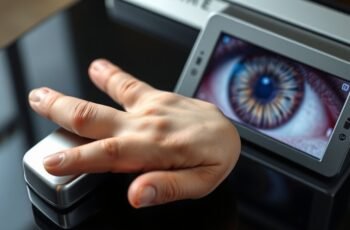
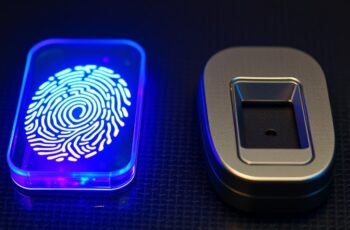
As the adage “what’s in a name?” suggests, the choice between palm vein and facial recognition hinges on more than branding—it’s about understanding their technical nuances. While both methods serve security purposes, their underlying mechanisms, vulnerabilities, and user implications differ considerably. To make an informed decision, we need to examine these technologies critically, weighing their strengths and limitations in real-world applications—an analysis that reveals much about how we balance security, privacy, and convenience.
Key Takeaways
- Palm vein recognition offers higher accuracy and security due to internal vascular patterns, making it more resistant to forgery than facial recognition.
- Facial recognition is more susceptible to environmental factors like lighting, expressions, and aging, affecting its reliability.
- Palm vein systems are contactless, hygienic, and simple to use, while facial recognition enables rapid, intuitive access.
- Palm vein data is highly encrypted and stored locally, providing better privacy protection compared to often cloud-based facial data.
- Cost and environmental resilience favor facial recognition for quick, scalable, and cost-effective deployment; palm vein suits highly secure environments.
How Do Palm Vein and Facial Recognition Work?
Although both palm vein and facial recognition systems serve to authenticate individuals, they operate through distinctly different biometric mechanisms. Palm vein recognition maps the unique internal vascular pattern of the palm, capturing the intricate arrangement of blood vessels beneath the skin. This pattern remains stable over time, making it highly reliable. In contrast, facial recognition analyzes external facial features, such as the distance between eyes, nose shape, and jawline, creating a detailed facial feature map. The system captures a 2D or 3D image, then compares the extracted facial features to stored templates. While palm pattern recognition relies on internal, subdermal features unaffected by external conditions, facial recognition depends on external features that can be influenced by lighting, angle, or aging.
Comparing Security and Accuracy of Palm Vein vs Facial Recognition
When evaluating biometric security systems, the focus often centers on their ability to reliably distinguish authorized individuals from potential impostors. Palm vein recognition typically offers higher biometric accuracy due to its unique vascular patterns, which are difficult to replicate or forge. Facial recognition, while convenient, is more susceptible to variations such as lighting, expression, and aging, impacting accuracy. Data privacy considerations also differ, with palm vein data being less exposed and more secure against theft. The table below compares key aspects:
| Aspect | Palm Vein | Facial Recognition |
|---|---|---|
| Biometric accuracy | High, resistant to forgery | Moderate, sensitive to environmental factors |
| Data privacy | Higher, internal biometric data | Lower, exposes visible features |
| Security robustness | Strong, difficult to spoof | Moderate, vulnerable to presentation attacks |
Convenience and User Experience: Which Method Is More User-Friendly?
Is convenience the deciding factor in choosing between palm vein and facial recognition systems? Both methods offer distinct user experiences shaped by user comfort and cultural acceptance. Palm vein systems tend to be more hygienic, requiring minimal physical contact, which enhances user comfort. They also generally involve straightforward hand placement, reducing user training and error, thereby streamlining the authentication process. Conversely, facial recognition relies on visual cues, enabling quick, contactless access that some users find more intuitive. However, cultural acceptance varies; in certain societies, facial recognition may encounter resistance due to privacy concerns or aesthetic preferences, affecting perceived user-friendliness. Ultimately, the choice hinges on balancing ease of use, cultural norms, and the physical interaction required to optimize user experience.
Privacy Concerns and Data Security in Biometric Authentication
While ease of use influences user acceptance of biometric systems, concerns surrounding privacy and data security are increasingly shaping their deployment and perception. Data encryption plays an essential role in safeguarding biometric templates, preventing unauthorized access. Legal compliance, such as GDPR and CCPA, mandates strict data handling protocols, emphasizing transparency and user consent. The table below compares biometric methods on these aspects:
| Aspect | Palm Vein | Facial Recognition | Common Concerns |
|---|---|---|---|
| Data Encryption | High-grade encryption | Moderate encryption | Data breaches, hacking |
| Legal Compliance | Easier due to biometric specificity | Challenging due to variability | Privacy violations |
| Data Storage | Localized, secured storage | Cloud-based, vulnerable | Unauthorized sharing |
| User Consent | Explicit consent required | Varies by jurisdiction | Unconsented data collection |
| Data Revocation | Straightforward deletion | Complex, especially with images | Data permanence concerns |
Ensuring data security and legal adherence remains central to user trust in biometric systems.
Which Biometric Method Is Better for Your Needs? Key Factors to Consider
Choosing the most suitable biometric method hinges on a thorough evaluation of factors such as security requirements, user convenience, environmental conditions, and data management policies. When comparing palm vein and facial recognition, biometric scalability plays a vital role; palm vein systems typically offer enhanced scalability due to their ease of integration in secure environments. Cost analysis is essential, as palm vein scanners generally involve higher initial investment but lower ongoing maintenance costs, whereas facial recognition systems often entail lower setup costs but may require frequent updates to address evolving security threats. Environmental factors also influence performance: facial recognition can be impacted by lighting conditions, while palm vein systems are more resilient in variable lighting. Ultimately, selecting the appropriate method depends on aligning these technical considerations with your specific operational needs.
Frequently Asked Questions
How Do Environmental Factors Affect Palm Vein and Facial Recognition Accuracy?
Environmental factors profoundly impact recognition accuracy, with sensitivity to lighting, temperature, and humidity influencing system robustness. Palm vein systems are less affected by lighting variations, whereas facial recognition systems require controlled conditions for reliable, precise identification.
What Are the Costs Associated With Implementing Each Biometric Technology?
Implementing palm vein and facial recognition involves costs like advanced sensor hardware, software integration, and ongoing maintenance, with security vulnerabilities and data privacy concerns requiring robust encryption and compliance measures, increasing overall investment and operational expenses.
Can These Biometric Systems Be Hacked or Spoofed Easily?
We find that biometric systems face security vulnerabilities; for example, facial recognition can be fooled with high-quality masks. While spoofing is challenging, ethical concerns arise from potential data breaches and misuse, demanding robust anti-spoofing measures and privacy safeguards.
How Do Demographic Differences Influence Recognition Success Rates?
Demographic biases and cultural impacts greatly influence recognition success rates, as biometric systems often perform variably across diverse populations, highlighting the need for inclusive, culturally aware algorithms to guarantee equitable accuracy and reduce bias in recognition technology.
What Are the Maintenance Requirements for Palm Vein Versus Facial Recognition Systems?
We find palm vein systems require minimal maintenance, mainly recalibration and sensor cleaning, preserving user privacy and reducing data storage concerns. Facial recognition demands regular software updates, camera alignment, and robust data management, impacting privacy and storage needs.
Conclusion
After analyzing both methods, we find that palm vein recognition offers superior security and environmental resilience due to internal vascular analysis, making it ideal for high-security settings. Facial recognition provides faster, contactless convenience but is more vulnerable to lighting and expression variations. While privacy concerns exist for both, technological advancements continue to mitigate risks. Ultimately, selecting the right biometric depends on your specific security needs, environmental conditions, and user experience priorities, underscoring the importance of a tailored approach.