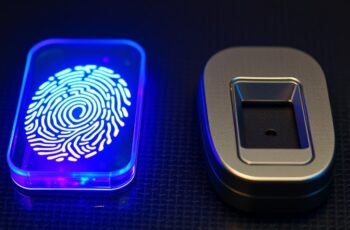
Imagine releasing your bank account with a simple glance or fingerprint, bypassing the need for complex passwords. As we evaluate biometric authentication against traditional passwords, we find a landscape marked by security challenges, user convenience, and privacy concerns. This comparison isn’t just about technology—it’s about shaping the future of secure banking. Understanding the nuances can help us determine which method truly offers the best balance of safety and usability.
Key Takeaways
- Biometric authentication offers higher security due to unique physiological traits, reducing risks from theft, hacking, and reuse common with passwords.
- Passwords rely on user memory and complexity, making them vulnerable to breaches, whereas biometrics provide seamless, contactless access.
- Biometric methods enable continuous and passive authentication, enhancing user convenience compared to manual password entry.
- Privacy concerns and irreversibility of biometric data pose ethical and security challenges not typically associated with passwords.
- Future banking security trends favor biometrics for their speed, ease of use, and integration into multi-factor authentication systems.
How Do Passwords Secure Banking Accounts?
Passwords serve as the primary line of defense in securing banking accounts by authenticating user identity before granting access to sensitive financial information. The effectiveness of this process hinges on password complexity, which involves creating unpredictable combinations of characters to thwart brute-force attacks. Robust authentication protocols enforce standards for password creation, requiring a mix of uppercase, lowercase, numbers, and symbols. These protocols also mandate regular password updates and account lockouts after multiple failed attempts, reducing vulnerability to credential theft. While passwords remain a fundamental security measure, their strength depends on adherence to these protocols and complexity requirements. Nonetheless, the reliance solely on passwords exposes inherent limitations, prompting ongoing research into supplementary or alternative authentication methods.
What Are the Benefits of Biometric Authentication in Banking?
Biometric authentication enhances security by providing unique, difficult-to-replicate identifiers that strengthen access controls. It also streamlines user experience, allowing for quick and seamless account verification without the need for memorized credentials. Together, these benefits address both risk mitigation and operational efficiency in banking systems.
Enhanced Security Measures
While traditional security methods often rely on static credentials, biometric authentication offers a robust, dynamic layer that enhances security in banking. This biometric innovation reduces reliance on password complexity, which can be vulnerable to brute-force attacks or social engineering. Biometric data is unique to each individual, making impersonation considerably more difficult. Additionally, biometric systems incorporate multi-factor authentication, further strengthening security. Key benefits include:
- Continuous biometric verification, reducing session hijacking risks
- Difficulties in replicating biometric identifiers
- Reduced dependency on users creating or remembering complex passwords
- Real-time detection of unauthorized access attempts
- Improved compliance with regulatory security standards
These factors collectively elevate security standards, making biometric authentication an essential enhancement over traditional password-based systems.
Convenient Access Experience
Implementing biometric authentication in banking considerably streamlines the user experience by enabling quick and effortless access to accounts. This technological innovation enhances user empowerment by reducing reliance on traditional passwords, which are often cumbersome and insecure. Biometric methods—such as fingerprint or facial recognition—provide immediate authentication, eliminating delays associated with manual input. This seamless access not only improves customer satisfaction but also encourages more frequent engagement with banking services. The intuitive nature of biometrics minimizes user frustration and error, fostering a more efficient interaction. Overall, biometric authentication offers a significant advantage in creating a convenient access experience, aligning with modern expectations for rapid, secure, and user-friendly banking solutions.
How Do Biometric Methods Compare to Passwords in Security?
Biometric authentication offers several advantages over traditional passwords in regard to security. It leverages unique physiological or behavioral traits, making it inherently more resistant to theft or guessing. Unlike password complexity, which can be compromised through brute-force attacks or social engineering, biometric systems rely on biometric accuracy, providing a higher security threshold.
- Difficult to replicate or share biometric data
- Eliminates risks associated with weak or reused passwords
- Reduces vulnerability to phishing attacks
- Offers continuous, passive authentication
- Enhances multi-factor security with biometric identifiers
While no system is infallible, biometrics markedly improve security by addressing vulnerabilities inherent in password-based systems. Their unique, hard-to-duplicate nature makes them a more robust safeguard for banking environments.
What Are the Limitations and Risks of Biometric Authentication?
Biometric authentication raises significant privacy concerns, as sensitive data like fingerprints and facial features can be targeted in data breaches. Additionally, the risk of spoofing and identity theft remains, where malicious actors may use fake biometric traits to deceive systems. Understanding these limitations is essential to evaluating biometric security’s overall robustness in banking.
Privacy Concerns and Data Breaches
While biometric authentication offers enhanced security through unique physiological traits, it also introduces significant privacy concerns and vulnerability to data breaches. Unlike passwords, biometric data cannot be easily changed if compromised, heightening risks. Data encryption plays a critical role in safeguarding biometric templates, but breaches can still expose sensitive information. User consent is essential, yet often insufficiently transparent or informed, raising ethical concerns.
- Centralized databases increase attack targets
- Breach of biometric data is irreversible
- Limited control over stored data post-collection
- Potential misuse of biometric information
- Challenges in ensuring proper data encryption standards
Spoofing and Identity Theft
Have we fully considered the vulnerabilities associated with biometric authentication methods? While biometrics are often seen as secure, they’re not immune to spoofing and identity theft. Attackers can create synthetic identities using manipulated biometric data or compromised sensors, enabling unauthorized access. Biometric credentials, once stolen, can facilitate financial fraud if used to bypass security measures. Unlike passwords, biometric data is immutable, making theft particularly risky, as it can’t be reset. Moreover, sophisticated deepfake and presentation attack techniques increase the threat of spoofing. These vulnerabilities highlight that biometric systems, despite their advantages, still face significant risks. We must recognize that biometric authentication is not infallible and implement layered security measures to mitigate potential exploitation.
How Do User Experience and Convenience Differ Between Both Methods?
Because user experience and convenience are essential factors in banking authentication, it’s important to compare how biometric methods and traditional passwords differ in these aspects. Biometric authentication generally enhances user comfort by enabling quick, touchless access, reducing cognitive load associated with remembering passwords. Interface design for biometrics often simplifies login processes, integrating seamless fingerprint or facial recognition. Conversely, password management can be cumbersome, requiring users to recall complex combinations.
Biometric authentication offers quick, touchless access, enhancing user comfort and simplifying login processes compared to traditional password management.
- Biometric methods provide faster, more intuitive access
- Passwords demand memorization and manual input
- Interface design for biometrics favors minimal steps
- User comfort improves with touchless, quick authentication
- Passwords can cause frustration during repeated authentication attempts
Which Authentication Method Is Better for the Future of Banking?
As banking continues to evolve toward greater security and user convenience, selecting the most suitable authentication method becomes increasingly critical. Future innovations suggest that biometric authentication, with its rapid technological advancements, will likely play a dominant role due to its enhanced security features and seamless integration into daily banking activities. However, ethical considerations—such as data privacy, consent, and potential misuse—must be carefully addressed to guarantee responsible deployment. Passwords, while familiar, face obsolescence as they are more vulnerable to breaches and less adaptable to emerging threats. Ultimately, the future of banking authentication might involve a hybrid model, leveraging both biometric and traditional methods, balancing security, user experience, and ethical integrity. This approach aims to optimize trust and resilience in financial systems.
How Can Banks Combine Both Methods for Optimal Security?
To achieve maximum security in banking, institutions must implement a layered authentication approach that integrates both biometric and traditional methods strategically. Combining these methods enhances security by leveraging multi-factor authentication (MFA) and user behavior analysis. This approach verifies identity through multiple layers, reducing vulnerability. Banks can, for example, require biometric verification alongside a password or PIN, then monitor user behavior for anomalies. Integrating behavioral analytics allows detection of suspicious activity, prompting additional verification steps. Continuous authentication guarantees security during sessions. To optimize this integration, banks should focus on:
- Implementing adaptive MFA based on risk levels
- Using biometric data for seamless access
- Analyzing login patterns for unusual activity
- Combining biometric and behavioral data for multi-layered security
- Regularly updating protocols to address emerging threats
Frequently Asked Questions
What Are the Privacy Concerns Associated With Biometric Data in Banking?
We recognize privacy concerns with biometric data, especially around data encryption and consent management, which are essential for secure storage and user control. Ensuring these measures are in place helps protect sensitive information from misuse and breaches.
How Do Biometric Authentication Costs Compare to Traditional Password Systems?
While biometric authentication entails higher initial implementation complexity and costs, its superior cost efficiency over time, through streamlined security and reduced password management, makes it a compelling choice for modern banking systems.
Can Biometric Data Be Legally Protected From Misuse or Theft?
We believe biometric data can be legally protected through strict data security measures and all-encompassing legal safeguards, ensuring misuse or theft is minimized. Implementing encryption and strict access controls enhances the integrity and confidentiality of biometric information.
How Do Different Demographics Perceive Biometric Versus Password Security?
We observe that user acceptance varies across demographics, influenced by cultural biases and trust levels; some perceive biometric security as more advanced, while others prefer passwords, emphasizing the need for tailored security approaches to address diverse perceptions effectively.
What Are the Technological Challenges in Implementing Biometric Systems Globally?
Implementing biometric systems globally faces hurdles like data interoperability and system scalability, which are critical for seamless integration. We grapple with these technical challenges, knowing resolving them determines whether security advances or stalls on a worldwide scale.
Conclusion
In the end, whether we trust passwords or biometric data, one thing’s clear: security is as much about convenience as it is about caution. Banks must dance a delicate waltz, balancing high-tech trust with privacy concerns—because after all, we’re willingly handing over our most personal traits. Combining both methods might just be the ultimate solution—ensuring security without sacrificing user experience. Or, at least, that’s the plan—until the next hacking scandal.